

Cue Sheets and the Music in Productions Industry Task Team (MIPITT)
Introduction
Imagine watching a film, TV series or advert with no music – just talk. Terrible! These productions rely on music’s magic to carry their message and create a mood. But this is an often neglected side to the music industry. For there to be music in any of these productions, songwriters and composers work hard to create the perfect soundtrack that makes a production magical.
Magic doesn’t come for free. Royalties are due to the composers and authors, and rights holders have to work hard to make sure they get paid these royalties. One of the most important documents required to identify the music used, is the Cue Sheet.
What are cue sheets?
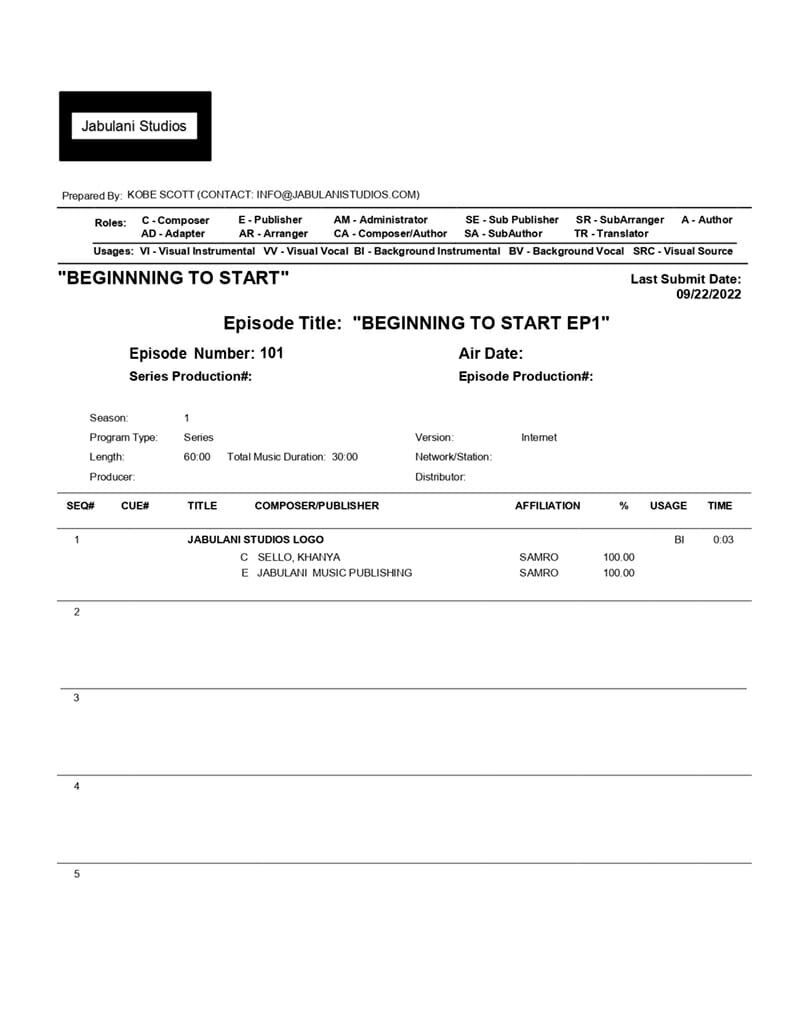
A Cue sheet is a document that lists all of the musical works incorporated in an audio/visual program. Cue sheets are used by Collective Management Organizations (“CMOs”) to determine who should receive performance and mechanical royalties.
Each cue sheet should identify the program it represents (e.g., a film, episode of a television show) and include the cue title, duration, usage, composers & authors and rights holder/s for each cue.
How does the process work?
Performance rights are needed to broadcast, and mechanical rights are needed whenever a copy is made to broadcast the production (this doesn’t include the initial ‘sync license’).
These rights are paid for by broadcasters, and whenever they pay they are supposed to send usage reports to make sure the correct rights holders and composers get their money. These usage reports include Cue Sheets.
The cue sheets are usually generated by production houses and are submitted to CMOs, usually via the broadcasters.
Flighting codes are usually generated by ad agencies and their producers.
This is the ideal scenario. However, cue sheets can feel like tax returns, and so producers sometimes don’t pay too much attention to getting them right, or even submitting them! And flighting codes are just a code, they don’t tell you what music was used. The collection management organizations (CMOs) like SAMRO (Southern African Music Rights Organization) and CAPASSO (Composers, Authors and Publishers Association) struggle to match what little information they receive from broadcasters, to what music their members tell them they have composed for productions. Rights holders and composers have a very hard time sourcing cue sheets in order to claim their dues. They are at the mercy of the broadcasters and producers.
Flighting Codes for South African Radio & Television
Another problem hindering royalty pay-outs is flighting codes.
Flighting codes are a unique code used to identify an advertisement or promo that is broadcast. Every advertisement on radio and television has its own flighting code that is created and submitted by the broadcaster to the collection management organization. Each version of an ad or promo gets a different flighting code – including ‘cut-downs’ which are different durations.
The problem is that nothing in the flighting code tells you what music was used. The only way to find out is to manually request this from the producer, who was commissioned by the agency.
So imagine how difficult it is to pay the correct rights holders and composer for hundreds of thousands of flighting codes every period! The sad reality is that royalties simply dam up, waiting to be claimed, until it’s too late to claim.
The Solution
The MPASA has partnered with Collective Management Organizations SAMRO and CAPASSO to form the Music in Productions Industry Task Team, or MIPITT. Members of the task team are contributing their expertise to identify all contributing factors that inhibit royalties from music in productions from finding their proper home. MIPITT aims to identify the problems from various angles and grow to include a wider stakeholder base.
Technology will play an increasingly important role in achieving MIPITT goals. Music Recognition Technology (“MRT”) can be used to supplement manual reporting and ease the processing burden (meaning more royalties), but MRT services rely on good metadata as well as ingestion of recordings into the system. There are also challenges when the tech has to identify music under voice-overs and other sounds.